
Menu
Table of Contents
| Principles | Concepts Introduced |
|---|---|
| There are 3 Domains in Existence | Physical, Quasiphysical and Metaphysical Domain |
We know the existence of thing through our perceptions of it. Each perception has 3 aspects:
- Physical
An example is a rock.
- Quasi-Physical
An example is space. We can see space. But we cannot touch or explain our perceptions of it without physical things.
- Metaphysical
An example is an idea. We know we have an idea, but we cannot see it nor touch it.
The two are one and the same thing displayed through different attributes:
- A circle existing in nature
- The idea of a circle existing

Let the investigation of forms, which are eternal and immutable, constitute metaphysics. Let the investigation of the efficient cause of matter, constitute physics.

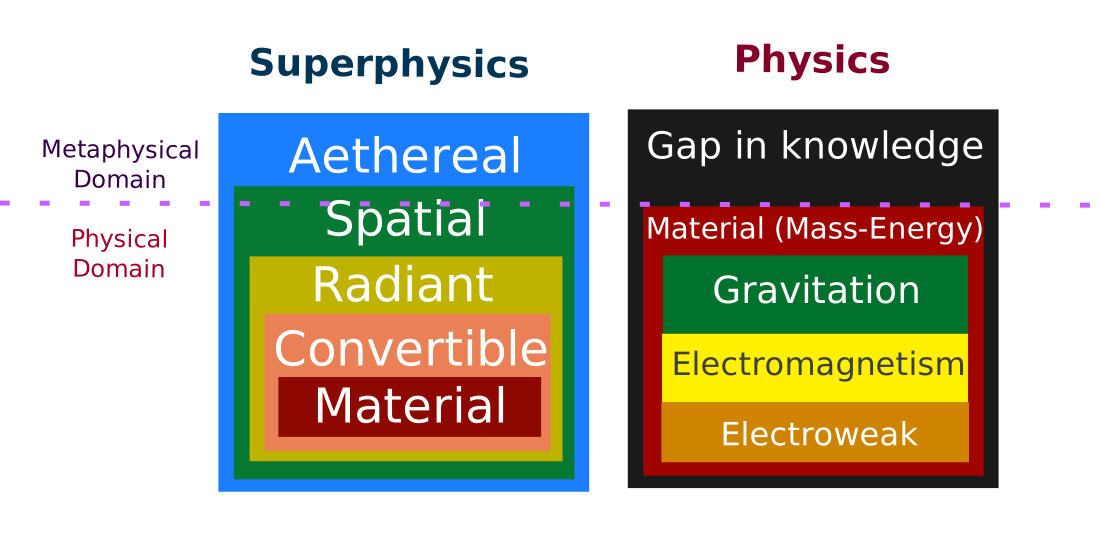
The Physical Domain
This domain exists only because of our physical senses, most commonly by:
- sight, which we classify as an ‘electromagnetic’ or ‘radiant’ type of perceptio
- touch, which is a ‘material’ type of perception
This will make sense when we talk about the 5 Layers of Reality that explains the ‘radiant’ and ‘material’ layers.
Your senses lets you perceive the rock physically by receiving the sensations of light and touch that bounce from the rock to you through the medium of space.
- It is this bouncing back that lets you know the rock exists.
- Likewise, the light and touch that bounce from you into the rock makes the rock know that you exist
This mutual bouncing back makes the rock and you exist to each other, by establishing a perception-relation which we call “relationality”.
Non-Existing Things Have No Relation to You
Invisible and intangible objects are those that do not let sensations of light or touch bounce back to you.
An example is the air which lets light pass through
The air has no relation to the eye and so is unseen. But it is related to the lungs which is very important for breathing.
Another example is spirits or elementals that is not seen by all people.
Spirits have no relation to people who choose physical pleasures. But they are very important to those who are on the spiritual path, just as money and physical assets are important to those on the materialistic path.
Humans should learn the difference between the idols of the human mind and the ideas of the divine mind. The former are mere arbitrary abstractions. The latter are the true marks of the Creator on his creatures, as they are imprinted on, and defined in matter, by true and exquisite touches.Truth and utility, therefore, are here perfectly identical. The effects are more valueable as pledges of truth rather than as practical benefits
The Quasi-Physical Domain
This domain exists in between the Physical and Metaphysical, bridging both.
This is the boundary of universes in the multiverse.
Space, time, and dimensions exist in this domain.
The Metaphysical Domain with Metaphysical Objects, as Ideas
The schools by natural philosophy were meant for the knowledge of the efficients or things concrete; and by metaphysics the knowledge of the forms of natures simple.
Modern science already knows a lot about the Physical Domain but knows nothing of the Metaphysical.
This is where Superphysics comes in.
This domain exists because our minds have an ethereal component that creates the necessary relation to the abstract ideas which serve as the primary objects of this domain.
Ideas Bounce Back. Or Not.
We are able to conceive an idea, or think of a thought, if it bounces back in our minds onto our consciousness just like how we are able to verify the existence of a rock by touching it.
We are unable to have that idea or thought if it does not bounce back to our consciousness.
An example of a metaphysical object not bouncing back is when we forget a password to our email.
The password was in our minds in the past. But our consciousness could not ‘find’ it because the effort that the mind exerts in remembering it does not bounce back with the actual password.
It would be like querying a database without the query returning anything.
Another example is a problem that we have no solution for, such as:
- how to increase sales that are declining, or
- how to make a device work.
In such cases, we think about the solution by:
- brainstorming, or
- tinkering with the device
Even then, the solution might still not reflect to our consciousness.
The solution might finally reflect after we:
- ask our customers directly, or
- read the device’s user manual.
At that moment, our minds feel a relief since its effort can end.
Aĺl men by nature desire to know. An indication of this is the delight we take in our senses which are useful and loved for themselves.

The Metaphysical Domain Versus the Physical Domain
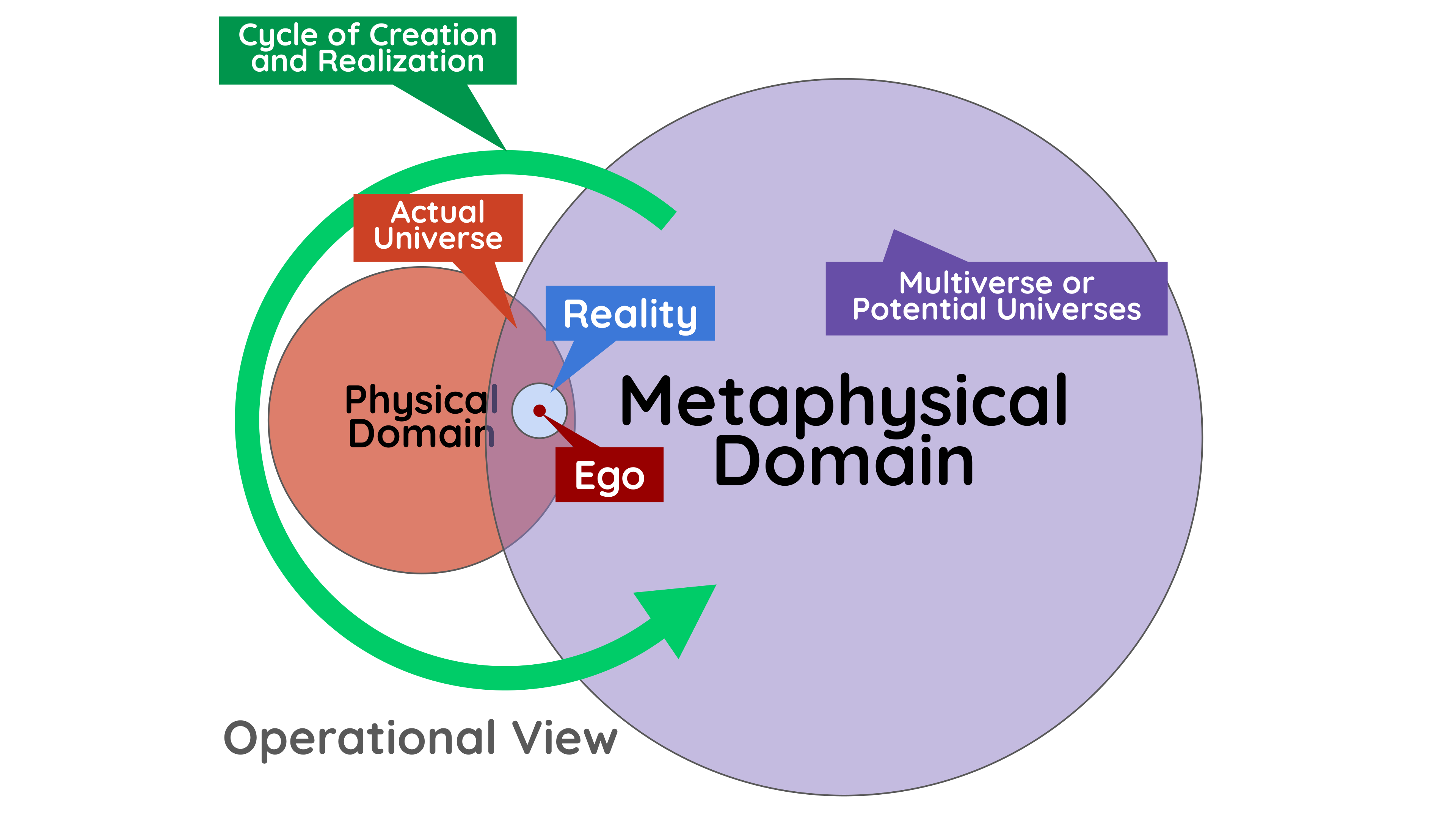
The metaphysical domain exists inside our abstract minds and is infinitely larger and richer than the physical domain of our senses. This is proven by our minds being ”rich” with ideas.
If Person A were to go from the lower to the middle region, he would imagine that he is going up. Person B is in the middle region but has never seen the true upper world. He sees Person A coming and imagines that he has arrived in the upper region. If Person A goes back down, Person B would imagine that he was descending. This would arise out of his ignorance of the true upper, middle, and lower regions.

We call this domain “aethereal” or made of aether or akasha in Hinduism. This will be explained later when we explain our Five Elements Model.
These causes generate an inequality which is always maintained, and is continually creating a perpetual motion of the elements… The brightest part is called the aether. The most turbid sort is mist and darkness.

These 3 regions of metaphysical domain, physical domain, and current perception (or quasi physical as a merger of both) are expressed in our Superphysics icon.

- The blue upward triangle reprsents the metaphysical domain going upwards
- The green downward triangle represents the physical domain going ‘down to earth’
- The yellow circle represents the focus of the mind as the here and now, as a combination of both. This includes reality or the universe, depending on context
The balance of the triangles represents the balance between the abstract and the concrete. We can’t focus on useless theory all the time. Nor can we go around doing physical actions without thinking of their causes and effects.
Inaction leads to nothing. But haste, on the contrary, also makes waste.
Human minds have limited abilities and so our focus must be relevant in order to maximize and concentrate what little we have.
For example, as a species, it would be better to focus on solutions to global warming than to think of how to make more money, create a new cryptocurrency, or predict the stock market. The latter ideas are really based on selfish-interest instead of the common-interest.
So what’s the use of the 3 domains?
The 3 domains frees up the limitation of beliefs which includes:
- materialist sciences as belief in physical evidence, by allowing metaphysical evidence
- religion by replacing the definition of (Anunnaki) God into the (metaphysical) Supreme Entity which is far more permissive
- philosophy by establishing critical thinking and critical feeling
- mysticism by enshrining the superiority of the metaphysical domain
- politics and social change and freeing up people from the rigid patterns of tyranny, capitalism or communism
- life events by freeing up the heart from the impositions from parents, society, employment, etc.
Definitions: Physical, Quasiphysical, Metaphysical
Physical is the nature of being detectable by the bodily senses. Technically, this is being part of the lower Elements or Layers such as the (Lower) Fire , Water, and Earth Elements, and the (Lower) Spatial, Convertible, and Material Layers.
Quasiphysical shares the nature of both Physical and Metaphysical. This is most evident in Elementals which can materialize.
Metaphysical is the nature of being detectable by the abstract mind without the direct support of the bodily senses. Technically being part of the upper Elements such as the (upper) Fire, Air, and Aether Elements, and the (Upper) Spatial, and Aethereal Layers.
Concepts Emerging from the 3 Domains
The concept of the 3 Domains leads to the following concepts:
- Reality
- Abstract Spaces of Reality
- Vortices and Ideas within Reality
- Operational Divisions of Reality
- The 5 Elements of Reality
- Relationality
Leave a Comment
Thank you for your comment!
It will appear after review.